Vehicles that actively improve air quality
The concept is not only zero-emission propulsion. It imagines a Canadian hydrogen fleet that also filters city air during normal driving.
Canadian innovation
Technology developed in Canada for a domestic and export hydrogen economy, drawing on fuel cell and clean-tech expertise.
BallardHTECEnergy sovereignty
White and green hydrogen can reduce dependence on imported petroleum while using Canadian hydroelectricity and geology.
White H2Green H2Net-positive mobility
Each kilometer is framed as avoiding tailpipe emissions while capturing particulate matter and a small stream of CO2.
3 m3 air/km12 g CO2/kmHydrogen physics
Hydrogen mass energy density is 120 MJ/kg, compared with about 46 MJ/kg for gasoline and much lower Li-ion battery density.
120 MJ/kg5-6 min refuelHydroMaxFuel PEM stack
The PEM fuel cell converts hydrogen and oxygen into electricity, heat and water without combustion: 2H2 + O2 -> 2H2O + energy.
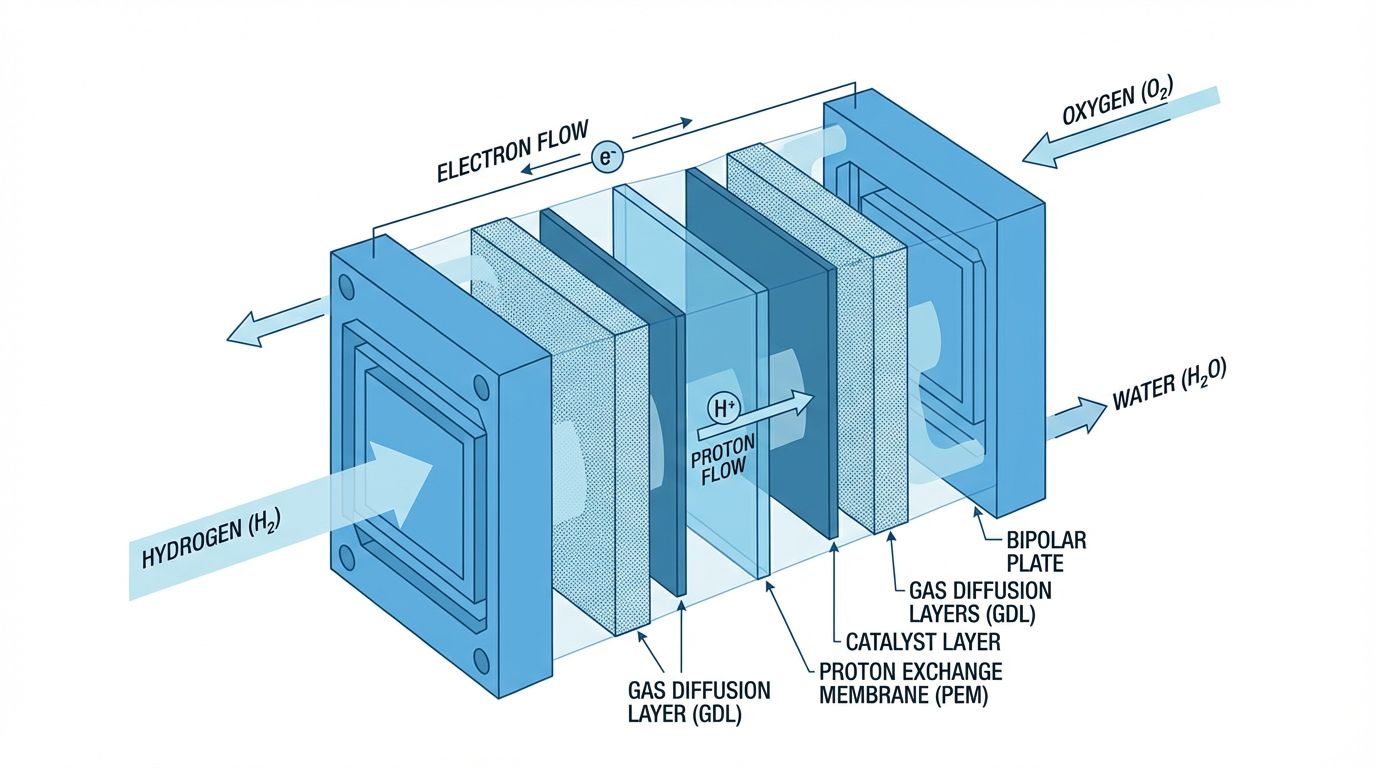
PEM fuel cell
The source specifies electrical efficiency above 60%, with a practical range of 55-65% once activation, ohmic and mass-transport losses are included. Each cell produces about 0.6-0.7 V under load; 300+ cells generate 200-400 V.
Functional layers
The stack includes a Nafion-type proton exchange membrane, platinum catalyst layers, gas diffusion layers, bipolar plates and a liquid thermal-management circuit maintained around 60-80 C.
Four-stage mobile depollution
TrinityClean turns vehicle airflow into a moving purification stream. At 60 km/h, the concept estimates roughly 500 m3/h of air through the system.
Electrostatic precipitation
A 30-60 kV DC corona field charges PM2.5, PM10, soot and metals so particles migrate to collector plates. Claimed capture: 99.5% without mechanical filters.
Direct air capture
Solid amine sorbents adsorb atmospheric CO2 at ambient temperature, with captured carbon converted into stable carbonate during maintenance cycles.
Low-temperature catalysis
A Pt-Pd/Al2O3 catalyst treats NOx, CO and VOCs using fuel-cell waste heat around 150-300 C, with claimed conversion above 98%.
Condensation and electrolysis
A thermoelectric condenser recovers atmospheric moisture and feeds a compact PEM electrolyzer. Recovered H2 becomes a small continuous supplement.
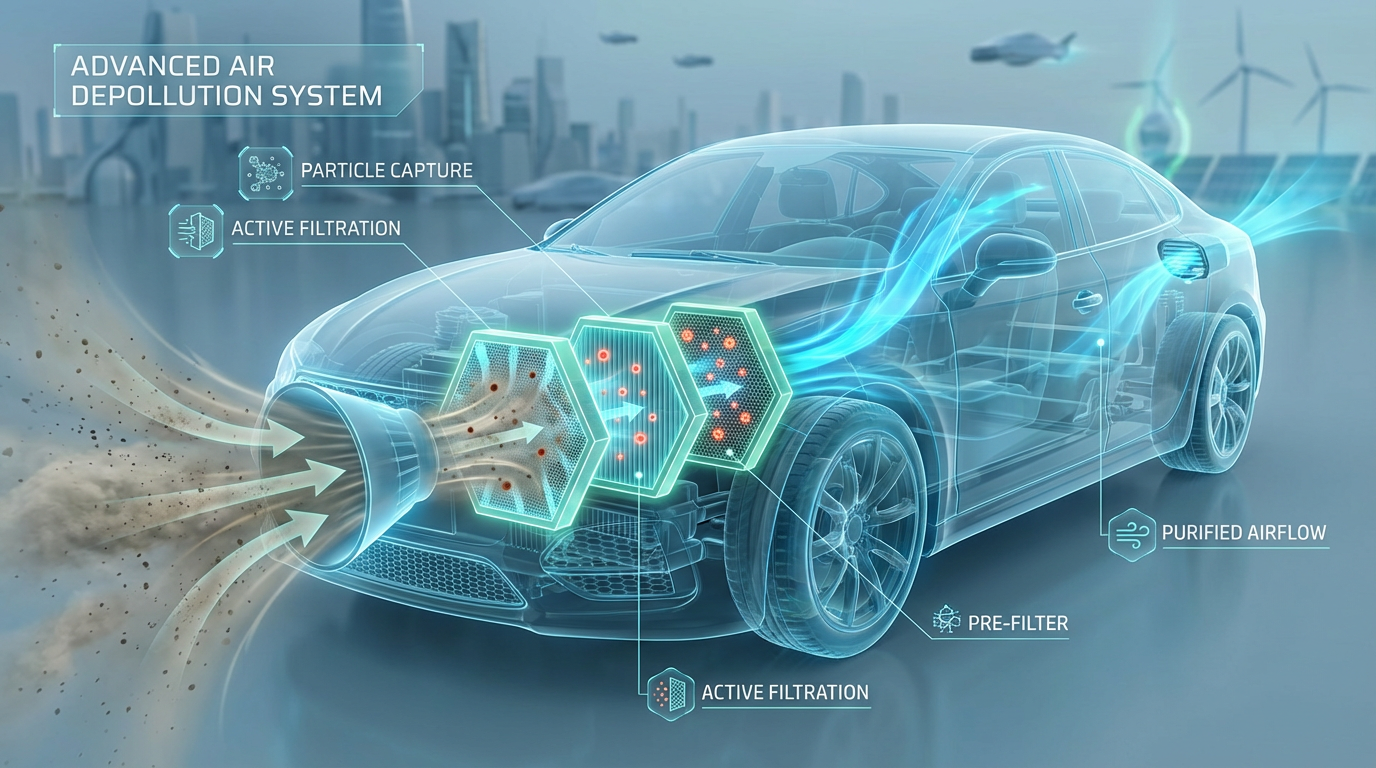
Integrated architecture
The four stages are arranged in an aerodynamic duct; fuel-cell heat regenerates DAC sorbents and warms the catalyst. The electrostatic precipitator consumes less than 50 W.
Performance claims
A national opportunity for clean mobility
Canada has hydroelectric capacity, white hydrogen geology, industrial partners and a national hydrogen strategy that can support mobility, industry and export.

Production pathways
The source covers PEM electrolysis, alkaline electrolysis, reforming with CCUS and geological white hydrogen. Costs range from less than $1/kg for potential natural H2 to $4-6/kg for green PEM electrolysis.
PEM electrolysisAlkalineCCUSWhite H2Canada's advantages
Canada holds 7% of global freshwater reserves and one of the world's largest hydroelectric bases. The national strategy identifies hydrogen as a pillar of the energy transition.
| Project | Hydrogen route | Status | Key point |
|---|---|---|---|
| Air Products Edmonton | Blue H2 | Under construction | $1.6B plant, 1,500 t H2/day, 95% CO2 capture |
| EverWind Point Tupper | Green H2 / ammonia | Approved | 1 GW wind export facility, $6B investment |
| HTEC British Columbia | Refueling network | Expanding | 25+ H2 stations and value-chain infrastructure |
| Hydro-Quebec Varennes | Green H2 | Under construction | 88 MW electrolyzer, 11,100 t H2/year |
| Saskatchewan white H2 | Geological H2 | Exploration | Canadian Shield reservoir potential |
The carbon fiber hydrogen SUV
The flagship vehicle combines a hydrogen fuel-cell drivetrain, CFRP monocoque chassis and integrated TrinityClean air processing.
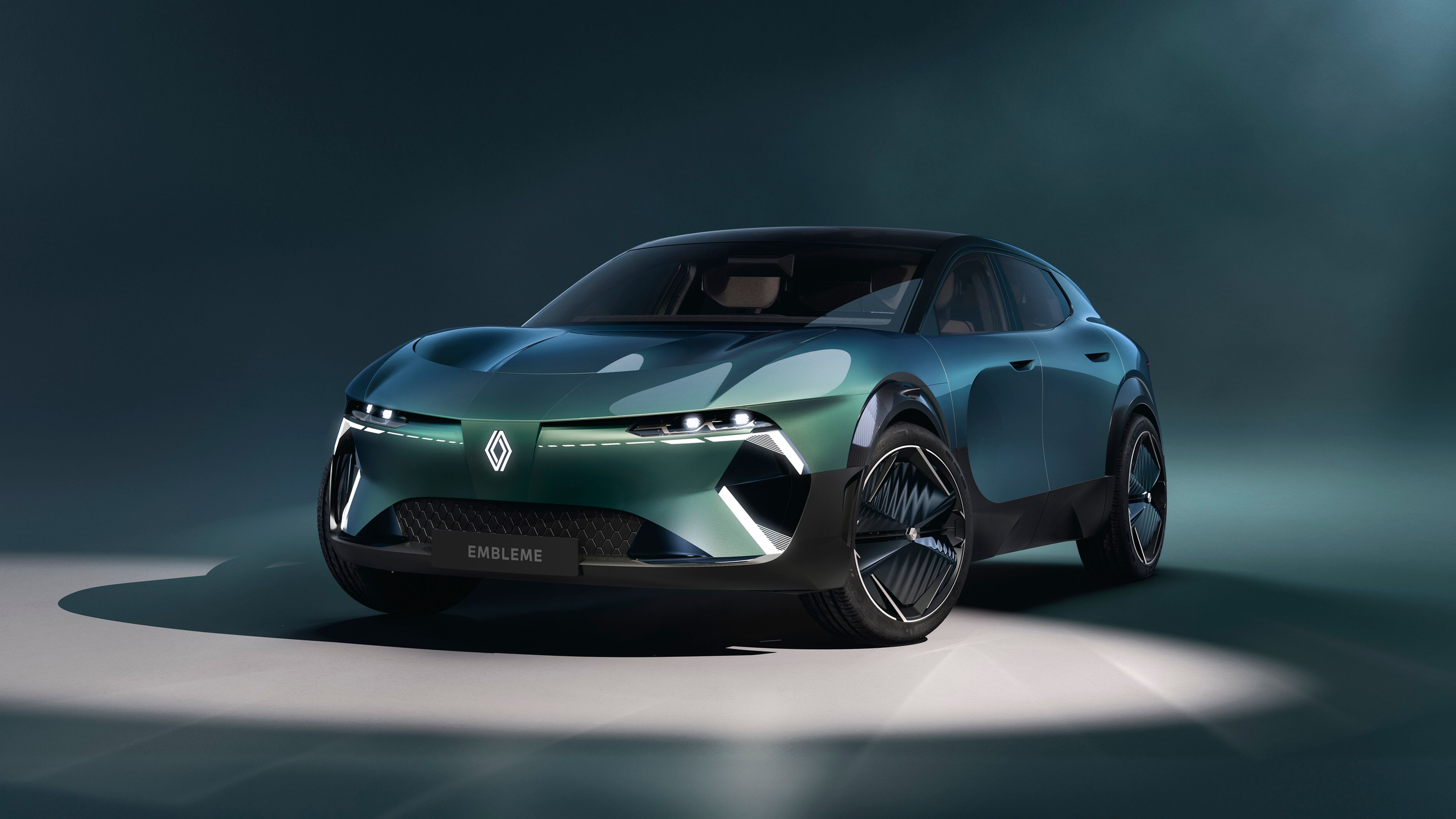
Designed to depollute. Built to last.
The VUS Terra concept uses a carbon fiber reinforced polymer monocoque, reducing structure mass and improving corrosion resistance for Canadian winter conditions.
Vehicle specifications
40% lighter chassis
CFRP reduces chassis mass from roughly 450 kg to about 270 kg versus conventional steel.
35,000 Nm/deg
Monocoque torsional rigidity supports handling, crash response and ride quality.
Corrosion resistance
Carbon fiber resists road salt, extending vehicle life in harsh Canadian winters.
95% fiber recovery
Pyrolysis recycling can recover carbon fibers from retired CFRP components.
A mobile urban depollution network
The source models the benefit of fleet deployment: traffic becomes a distributed air-treatment network while replacing combustion emissions.

Impact model
The calculator uses kilometers driven, usage days and fleet size to estimate avoided CO2, purified air, captured CO2 and tree-equivalent benefits.
10,000 vehicle vision
A metropolitan fleet of 10,000 TrinityMotors vehicles is framed as a mobile network capable of purifying billions of cubic meters of air per day.
An ecosystem for Canadian hydrogen mobility
The source proposes partnerships across industry, universities, municipalities and investors to standardize hydrogen infrastructure and accelerate deployment.

Partner map
Industrial partners include Ballard Power Systems, HTEC, Ionomr, FortisBC Energy and Ekona Power. Research partners include Waterloo, SFU, University of Toronto, UQTR and Ontario Tech.
200+ H2 stations by 2035University R&DMunicipal pilots
Investment thesis
The case cites a global hydrogen market projected around $2.5T by 2050, more than $100B in Canadian H2 investments, a patented depollution platform, and a team drawn from fuel-cell and research ecosystems.
$2.5T by 2050$100B+ Canada H2TrinityClean IP